 Properly managed project documentation is critical for all types and sizes of projects. After all, the project documentation is the only real output from most projects. It is not the prototype that matters. It is the production documentation that includes things such as material lists, part drawings, assembly instructions, diagnostics, and source code that defines our products and services. I’m sure this is nothing profound to any of you. However, what you may not realize is that making it easy for everyone to find the latest version of a given document is especially important for virtual teams. Virtual teams often consist of people from different time zones or who work different schedules (i.e., a four-day week). As such, these teams rely more heavily on online sources of documentation throughout their work week. If they struggle to find the latest documentation on some aspect of the project that affects them, they’ll waste time sending e-mails, calling around or worse still, end up using an outdated version by mistake. Continue reading
Everybody's Talking
 Lindsay Blakely at BNET interviews Tammy Erickson of Harvard Business blog here about doing away with outdated time-based management by enacting a Results Only Working Environment. While ROWE can be used effectively by in-office workers, such a results-based performance measurement system is ideal for telecommuters and remote workers.
The Management Issues blog lists five “don’ts” here that anyone planning a telecommute program should avoid. Successful telecommuting needs some well-considered structure.
Workforce.com discusses Accenture’s efforts to maintain a sense of community among remote workers and promote the retention of remote employees here.
It'll Never Work
 “If you think you can do a thing or you think you can’t do a thing, you’re right.” – Henry Ford
Is your company telecommute-ready? Listen to people talk:
“You have to be face-to-face to do business.”
“Strong teams have to be co-located.”
“A good business relationship begins with a handshake.”
“You can’t hide behind all that email stuff. You have to be there.”
Sure, telecommuting saves employees money. It saves employers business travel costs and some of the costs of providing office space. It reduces pollution. It saves commute time, which employees most commonly use to do more work. It improves work/life balance, employee satisfaction, and retention.
Hello world!
Welcome to WordPress. This is your first post. Edit or delete it, then start blogging!
When meeting face to face isn't better
 Have you ever done affinity diagramming? That’s the brainstorming exercise in which each participant in a conference room is given a pad of sticky notes and asked to write as many ideas as possible about an issue or solutions to a problem on them, one idea per sheet. After a few minutes, the meeting facilitator invites participants to arrange their notes on a board or a wall, placing similar ideas together. After a few minutes of elbowing and toe stomping and dropped bits of paper, the stickies end up clumped together and some major answers emerge. It’s a very powerful technique for thinking as a team. Continue reading
Whiteboarding for Virtual Teams
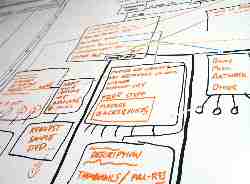 One of the most useful things I have learned leading teams is that pictures are a very effective way to help people understand complex ideas. I am sure you have all heard that there are auditory learners and visual learners, but in my experience, a good visual is much better than audio for most people. I have been in countless meetings where a discussion goes on and on with no apparent conclusion or convergence toward an answer until someone goes up to the board and draws a picture of the ‘situation’. The dynamics in the meeting immediately transform. Understanding increases, more people are engaged to help draw the picture, and things get moving again. People need a way to form a mental image of complex problems, to connect abstract ideas with things they already understand. This is why drawing even a simple flow or relationship diagram can help people understand the most difficult concepts. Continue reading
Multi-Tasking in Project Meetings
 In my many years in the technology industry, I’ve spent thousands of hours in meetings, most of them as boring as all get-out. During this time I’ve seen many interesting changes. I’ve seen meeting presentation technology evolve from flip charts and story boards, to overheads, to video projectors, and most recently, to laptops in front of each participant. I’ve seen virtual meetings evolve from a rarity to a common occurence. But, one thing that has persisted in all the years is people not paying attention. Continue reading
Project Progress Trend Analysis
 If you are like most project managers, you wish you had a better real-time handle on the progress of your project so you could predict when you will finish or when a change is needed in order to stay on track. I have used a simple yet powerful method that is applicable to most projects and can tell you months in advance if you are off track or if scope creep is threatening to destroy your schedule. The method is straightforward and only requires a detailed task list and that the tasks are checked off as the project progresses. If you spend the time with the project team to develop a detailed work breakdown schedule (WBS), you have all the data you need for this method. WBS data should be available for even the simplest projects and is often in spreadsheet form as a simple list of tasks, making the method described here very easy to implement. The method is far easier to use to monitor progress and identify when things are going awry than either PERT or Gantt charts. Here is the method:
Vision and Mission Statements Revisited
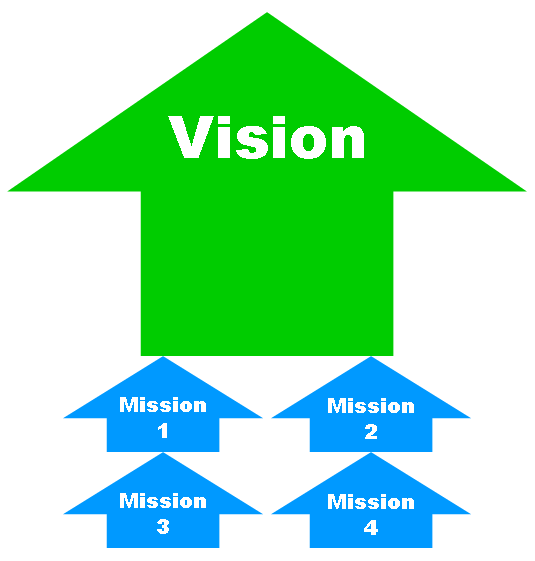 I’m sure you have had a chance to write a vision or mission statement at one time or another in your career. In my 25 years in high-tech corporate life, I’ve seen hundreds. Unfortunately, most of them were poorly written because the authors failed to capture the true goal of a vision statement, and missed the boat completely on what they called a Mission Statement. I think the reasons for this are obvious…we were never taught how to write them properly. Isn’t that the reason for most of our problems in life? In any case, let’s begin with the Vision statement.
Communicating Effectively in Virtual Teams: Part 4 of 4
 In this final part of my series on communications in virtual teams, I will discuss the most important medium to evolve so far during the computer revolution: e-mail. Pretty much everyone has an e-mail address these days, and many of us have several. E-mail is the primary information channel in corporations across the globe. It allows us to send everything from short text messages to detailed project proposals with product specifications to anyone, anywhere on the planet, at any time. It is a non-real-time mode of communication as messages are queued up in one’s inbox for reading when convenient. Continue reading