 Every project manager worthy of the title knows why effective teamwork is critical to project success. All members of great teams know their own roles, limitations and strengths, as well as those of everyone else on the team. They use this knowledge to avoid duplication, anticipate problems, and quickly determine who is most able and qualified to take on a new project assignment. These teams operate with minimal management oversight. In fact, wherever you find a micromanaging team leader, you are sure to find a poorly functioning team. Obviously there are many other factors that cause teams to malfunction (i.e., lack of clarity of purpose, roles, skills, etc.), but one factor is always critical: good teamwork. Continue reading
Author Archives: Loyal
How Good Are Virtual Team Relationships?

In my many years working virtually, I’ve come to realize that business relationships with virtual colleagues can be every bit as strong as those with colleagues in a traditional office setting. I’ve had many people tell me that face-to-face is the only way to build teamwork. Until fairly recently, however, I had no concrete examples to prove these people wrong. Continue reading
Are you spending too much time planning?
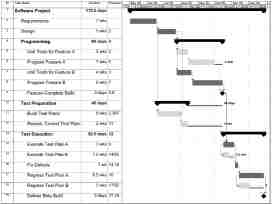 This may sound blasphemous to a professional project manager, but it is possible to over-plan. I have seen it happen countless times. It begins with a project manager with moderate analytical tendencies (e.g., an engineer) who has access to that ubiquitous project scheduling program, Microsoft Project. Actually, it does not have to be Microsoft Project–any program with similar capabilities will yield the same results. Continue reading
Two great uses for SR
 I have found two great uses of speech recognition for telecommuters. But, before I tell you what they are, I’d like to give you some background on my experience with speech recognition software.
My SR Learning Experience
My typing speed varies between 80 and 150 wpm, depending on how much sleep I’ve had the previous night and my caffeine intake at that point in the day. The more caffeine, the slower my net speed due to the increased frequency of the backspace key–the most used key on my keyboard. As you can imagine, this speed was taking a toll on my wrists. Since my job required me to write a great deal, I found I was starting to experience some repetitive motion pain. Before the pain turned to injury, I decided to give speech recognition (SR) software a try. I had already tried an ergo keyboard, which helped, but being the geek I am, I wanted to try out something I felt could really fix my problem. I figured, why type at all, when the computer (theoretically) could do it for me! Continue reading
Knowledge Management for Virtual (and non-virtual) Teams
 Properly managed project documentation is critical for all types and sizes of projects. After all, the project documentation is the only real output from most projects. It is not the prototype that matters. It is the production documentation that includes things such as material lists, part drawings, assembly instructions, diagnostics, and source code that defines our products and services. I’m sure this is nothing profound to any of you. However, what you may not realize is that making it easy for everyone to find the latest version of a given document is especially important for virtual teams. Virtual teams often consist of people from different time zones or who work different schedules (i.e., a four-day week). As such, these teams rely more heavily on online sources of documentation throughout their work week. If they struggle to find the latest documentation on some aspect of the project that affects them, they’ll waste time sending e-mails, calling around or worse still, end up using an outdated version by mistake. Continue reading
Knowledge Management for Virtual Teams
Properly managed project documentation is critical for all types and sizes of projects. After all, the project documentation is the only real output from most projects. It is not the prototype that matters. It is the production documentation that includes things such as material lists, part drawings, assembly instructions, diagnostics, and source code that defines our products and services. I’m sure this is nothing profound to any of you. However, what you may not realize is that making it easy for everyone to find the latest version of a given document is especially important for virtual teams. Virtual teams often consist of people from different time zones or who work different schedules (i.e., a four-day week). As such, these teams rely more heavily on online sources of documentation throughout their work week. If they struggle to find the latest documentation on some aspect of the project that affects them, they’ll waste time sending e-mails, calling around or worse still, end up using an outdated version by mistake. Continue reading
Whiteboarding for Virtual Teams
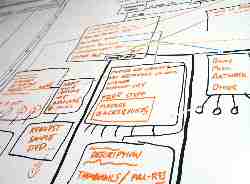 One of the most useful things I have learned leading teams is that pictures are a very effective way to help people understand complex ideas. I am sure you have all heard that there are auditory learners and visual learners, but in my experience, a good visual is much better than audio for most people. I have been in countless meetings where a discussion goes on and on with no apparent conclusion or convergence toward an answer until someone goes up to the board and draws a picture of the ‘situation’. The dynamics in the meeting immediately transform. Understanding increases, more people are engaged to help draw the picture, and things get moving again. People need a way to form a mental image of complex problems, to connect abstract ideas with things they already understand. This is why drawing even a simple flow or relationship diagram can help people understand the most difficult concepts. Continue reading
Multi-Tasking in Project Meetings
 In my many years in the technology industry, I’ve spent thousands of hours in meetings, most of them as boring as all get-out. During this time I’ve seen many interesting changes. I’ve seen meeting presentation technology evolve from flip charts and story boards, to overheads, to video projectors, and most recently, to laptops in front of each participant. I’ve seen virtual meetings evolve from a rarity to a common occurence. But, one thing that has persisted in all the years is people not paying attention. Continue reading
Project Progress Trend Analysis
 If you are like most project managers, you wish you had a better real-time handle on the progress of your project so you could predict when you will finish or when a change is needed in order to stay on track. I have used a simple yet powerful method that is applicable to most projects and can tell you months in advance if you are off track or if scope creep is threatening to destroy your schedule. The method is straightforward and only requires a detailed task list and that the tasks are checked off as the project progresses. If you spend the time with the project team to develop a detailed work breakdown schedule (WBS), you have all the data you need for this method. WBS data should be available for even the simplest projects and is often in spreadsheet form as a simple list of tasks, making the method described here very easy to implement. The method is far easier to use to monitor progress and identify when things are going awry than either PERT or Gantt charts. Here is the method:
Vision and Mission Statements Revisited
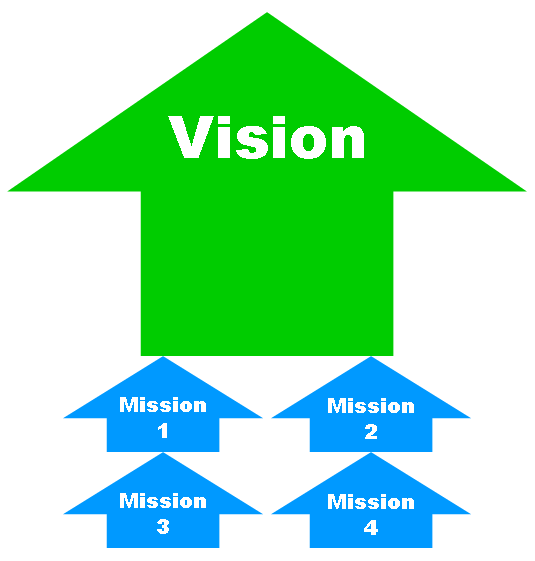 I’m sure you have had a chance to write a vision or mission statement at one time or another in your career. In my 25 years in high-tech corporate life, I’ve seen hundreds. Unfortunately, most of them were poorly written because the authors failed to capture the true goal of a vision statement, and missed the boat completely on what they called a Mission Statement. I think the reasons for this are obvious…we were never taught how to write them properly. Isn’t that the reason for most of our problems in life? In any case, let’s begin with the Vision statement.